
How to Assess a Patient with Chronic Dizziness (In a Way That Starts Recovery)
Dr. Yonit Arthur, AuD, Board-Certified Audiologist and founder of The Steady Coach
If you support clients struggling with chronic dizziness, you know how often standard intake protocols fall short. You might ask, "When did it start?" or "What makes it better or worse?" and still feel like you are missing the bigger picture.
Those questions are necessary, but they often fail to reveal how the nervous system has learned the dizziness pattern. They do not expose how fear and meaning shape the experience, or how much a client’s life has shrunk in response. If you want to help people move past chronic dizziness, you must change how you listen. This applies to PPPD, vestibular migraine, Mal de Debarquement syndrome, post-concussion syndrome, and many other forms of chronic dizziness.
Key Takeaways
Standard vestibular intakes often miss the cognitive and behavioral loops that reinforce chronic dizziness.
Understanding the origin story of a client's dizziness helps identify the fear and uncertainty that primed their nervous system for a protection pattern.
Clinicians and coaches can improve outcomes by assessing monitoring behaviors, avoidance patterns, and catastrophic beliefs alongside vestibular function.
Shifting a client's belief about their prognosis is a critical step in guiding the nervous system toward safety and recovery.
Identifying the Origin Story and Narrative
While a timeline is helpful, the story around the first event is even more critical. You need to understand how the nervous system interpreted that initial experience.
Consider asking:
"Tell me about the first time you remember this dizziness becoming a problem. What was happening in your life then?"
"How did you make sense of the experience? What did you think was happening to you?"
"What did your first provider say? What was ruled out? What remained unclear?"
Listen for a first insult, such as vestibular neuritis, a concussion, motion exposure, or a major stress event. Assess how frightening that event was and how much uncertainty surrounded it. You are listening for the loss of safety that primed the nervous system to wire in a protection pattern.
Clarifying the Medical Landscape
You need to respect the need to rule out dangerous pathology, but avoid duplicating previous efforts. Focus on understanding the client's experience with the medical system.
Ask:
"Which tests have you had so far, such as an MRI or vestibular testing?"
"What did your providers say about those results?"
"Was there ever a time someone found something but noted it did not fully explain your symptoms?"
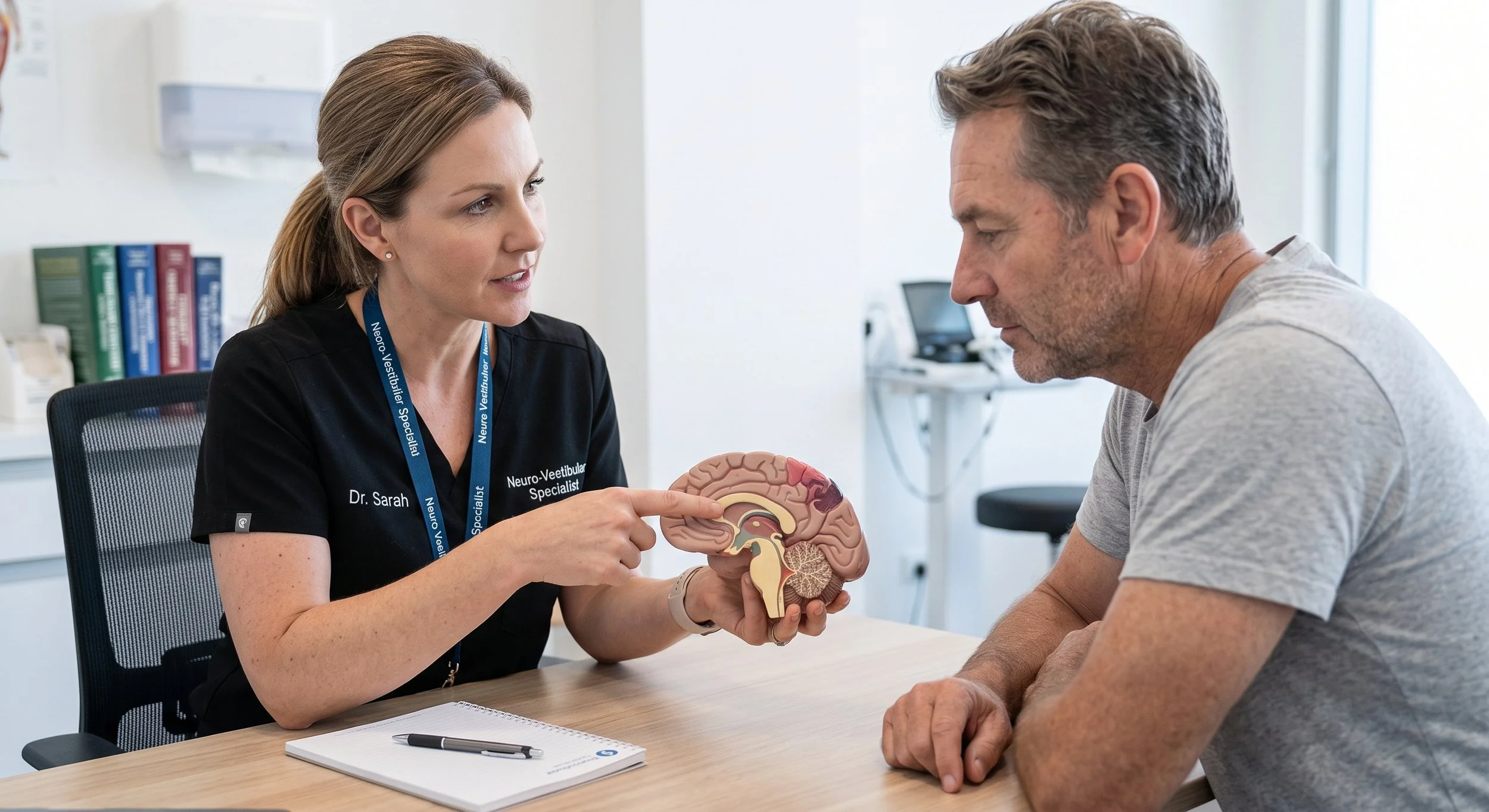
Your goal is to identify if there is still a plausible structural issue or if you are in clear neural circuit territory.
Addressing Fear, Beliefs, and Catastrophic Thinking
Neural circuit dizziness is driven by the brain's interpretation of sensations. If you ignore the cognitive and emotional layer, standard rehabilitation exercises will be less effective at calming the nervous system.
Try these questions:
"When you feel dizzy, what thoughts rush through your mind?"
"What is the worst outcome you fear?"
"Has anyone suggested a scary diagnosis that stuck with you?"
Common fears include concerns about falling, passing out, or having a permanent, degenerative condition. These fears are often the cognitive drivers you need to address to help the nervous system feel safe again.
Uncovering Monitoring and Avoidance Patterns
Fear manifests in behaviors that often keep the nervous system in a state of high alert. Identify these patterns to create effective goals for your work together.
Ask:
"What activities have you stopped doing because of dizziness?"
"How do you change your behavior when you are grocery shopping, driving, or socializing?"
"How often do you check in with your body for symptoms?"
"What is your current relationship with online symptom forums?"
You are looking for evidence of a withdrawn life, such as social isolation or avoidance of travel, and safety behaviors like constant scanning. These become the targets for your guidance as you help the client reverse these patterns.
Evaluating Beliefs About Prognosis
A client’s belief about the future dictates their present behavior. If they are convinced this is a life sentence, their nervous system remains in persistent threat mode.
Ask:
"If nothing changed, how do you imagine your life one year from now?"
"Deep down, what do you believe is possible for your recovery?"
"Have providers told you this is something you must simply live with?"
Your role is to help shift this narrative. You can provide a clear, evidence-based explanation of how neural circuits and plasticity work, offering a path forward that focuses on potential rather than limitation.
Exploring Nervous System History
Dizziness patterns are rarely isolated events. They are often built upon a nervous system already primed for protection.
Ask:
"Before dizziness was an issue, how did your body react to stress?"
"Do you have a history of anxiety, pain, or other unexplained symptoms?"
"Were there any major stressors or losses in your life around the time symptoms began?"
This is not about pathologizing the past. It is about understanding how the nervous system was already wired to latch onto a dizziness event and turn it into a long-term pattern.
Recognizing Opportunities for Change
Finally, identify where the cracks of possibility exist. Look for moments when symptoms fluctuate, as these provide clues for your work together.
Ask:
"Are there times when symptoms seem to ease up, such as in certain environments or mindsets?"
"Have there been days where you were surprised you could do more than usual?"
"What is one activity you are still doing that matters to you?"
These answers reveal where contextual modulation is already happening and provide starting points for safely expanding life and activity.
Ready to Transform Your Practice?
If you are tired of standard protocols that leave your clients stuck in the loop of persistent dizziness, it is time to change your approach. I invite you to join a community of clinicians and health coaches who are mastering the art of guiding neural circuit dizziness recovery. Click here to learn more about The Steady Framework Foundations course and join our waitlist for the next cohort.
About the Author
Dr. Yonit Arthur, AuD, is a board-certified audiologist and coach who specializes in guiding those with chronic dizziness and persistent vestibular symptoms. She coined the term Neural Circuit Dizziness (NCD) and developed The Steady Framework, a training program that teaches clinicians and health coaches to bridge the gap between clinical pathology and behavioral recovery. Dr. Arthur holds advanced certifications in vestibular rehabilitation, concussion treatment, and strength coaching, and is trained in experiential counseling modalities including IFS and coherence therapy. With a dedicated YouTube community of over 60,000 subscribers, she has guided thousands to recovery and mentored many professionals. Often known as “Dr. Yo,” she has been a featured speaker at conferences for the Stress Illness Recovery Practitioners Association (SIRPA) and the Association for the Treatment of Neuroplastic Symptoms (ATNS). Dr. Arthur is passionate about equipping practitioners with the tools to help people who standard care often leaves behind. Learn more about her practitioner-focused training at thesteadycoach.com/practitioners .